Totally forgot about this, used Gemini 3 Pro for this:
English:
Narrator: Over four billion recorded and blank cassettes go over the counter annually. It is no wonder that the electronics multinational Philips, the actual inventor of the cassette, continues to bet on this system. And with the newest cassette generation, even the last disadvantages regarding CD quality have been eliminated: at the Fera, which opens its doors tomorrow, the company Philips is introducing its new DCC, the Digital Compact Cassette.
Narrator: But a European novelty is promptly faced by a Japanese one. With an incomparably larger effort, Sony is launching the recordable CD tomorrow: the MiniDisc. In the battle for the ear of the music consumer, the contribution by Beatrice Stebler.
(Music / Montage)
Narrator: Whoever consumes music today has long since grasped it: Vinyl records are out, CDs are in. But that is not enough. Now the cassette has also served its time. In the future, everyone can record their favorite music on digital sound carriers—but on which ones? In the battle for the ear, the HiFi giants Philips and Sony are fighting.
Philips Representative (German): Well, we don’t see this as a war at all; we see these as totally different products.
Sony Representative (Swiss German): I believe basically that the market is large enough that these different systems could coexist side-by-side.
Narrator: So, no fight. But both certainly want to sell their devices. Sony, at any rate, armed up in time for the Fera and launched the MiniDisc. MiniDisc: that is a tiny thing that combines the properties of the tape cassette and the CD. Recorded or unrecorded, [it has] digital sound, quick access, is shock-proof and therefore portable. If it goes according to Sony, the MiniDisc should ring in a new audio age.
Narrator: Whether it succeeds? Philips, the competition, does not believe that this can be done so quickly.
Philips Representative: Yes, the difference is that with the MiniDisc, one is talking about a totally new system. And that is—let’s say comparable to the introduction of the CD—there you have to start all over again. People need to buy so many devices and many pre-recorded things before they can use it. And history shows, for example [with] CD, that although it went very fast, it is always a very slow concept whereby only after 10 or 15 years does a significant number of people use these things.
Narrator: Philips therefore does not want to overwhelm the clientele with a completely new device. It holds onto the proven cassette system but equips it with digital technology. DCC thus offers CD comfort and digital music enjoyment. Recorded and blank cassettes are also offered here. Additionally—and this is Philips’ trump card—the old, already collected cassettes can also be played on the DCC devices. With the DCC, Philips wants to land another coup on the market. Sony, the competition, does not believe they have the right to do so.
Sony Representative: I believe the decisive factor for me, which presents itself for the consumer, is the question: If he lacks a new medium… if he now chooses a digital medium, then he should choose one that serves him for the next 30 years. And with the cassette, I am fundamentally of the opinion that the cassette builds on a 30-year-old technology. And that is a bit… how should I say… that is like a steam locomotive with a turbo built into it.
Narrator: Advantages and disadvantages, then, for both systems. And when deciding, it could become a real storm for some. The battle will hardly be decided by price. Whoever invests around 1,000 Francs is in with both Sony and Philips. The digital sound carriers cost 15 Francs each. But is the investment worth it? After all, millions of people were satisfied with the old cassette devices until today.
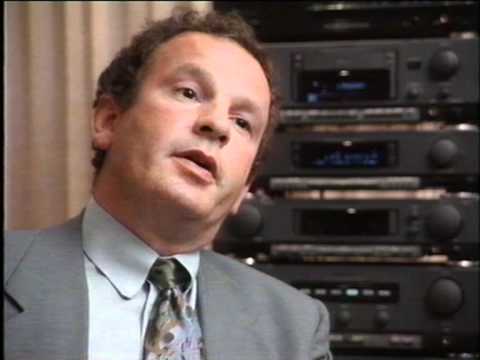
Sound Engineer (Swiss German): You see, what I fear with the new systems… one must make certain compromises somewhere regarding data compression so that one can bring this onto these systems at all. Then perhaps a noble HiFi freak might say, “Yes, that sounds a little less good”. Or for a normal consumer, who sits on the beach with a ghetto blaster or something similar, it perhaps doesn’t play such a role what he has. And, I believe for people it is still important what kind of music is on it, and it’s actually all the same to them on what [it is played].
Narrator: Sound Master Merz must know. After all, he is responsible for the sound quality on record recordings by Polo Hofer. His ear is certainly fine, his love for pure sound certainly great. Nevertheless, he would purchase neither the MiniDisc nor the DCC at the moment.
Sound Engineer: I would wait for now. I mean, honestly, I can’t let myself jump on everything new every half year, although something new is always coming.
Narrator: Conclusion for the consumer: Whoever wants to buy, buys. The others leave it be.
Dutch:
Verteller: Wie vandaag muziek consumeert, heeft het allang begrepen: grammofoonplaten zijn uit, CD’s zijn in. Maar daarmee is het niet genoeg. Nu heeft ook de cassette haar tijd gehad. In de toekomst kan iedereen zijn lievelingsmuziek op digitale geluidsdragers opnemen—alleen, op welke? In de strijd om het oor twisten de HiFi-giganten Philips en Sony.
Philips-vertegenwoordiger (Duits): Nou, wij zien dat helemaal niet als een oorlog; wij zien dat als totaal verschillende producten.
Sony-vertegenwoordiger (Zwitserduits): Ik geloof in principe dat de markt groot genoeg is, zodat die verschillende systemen naast elkaar zouden kunnen coëxisteren.
Verteller: Geen strijd dus. Maar verkopen willen ze hun apparaten beslist allebei. Sony heeft zich in ieder geval tijdig voor de Fera bewapend en de MiniDisc gelanceerd. MiniDisc: dat is een piepklein ding dat de eigenschappen van de bandcassette en de CD verenigt. Bespeeld of onbespeeld te hebben, met digitaal geluid, snelle toegang, schokbestendig en daardoor draagbaar. Als het aan Sony ligt, moet de MiniDisc een nieuw audiotijdperk inluiden.
Verteller: Of het lukt? Philips, de concurrentie, gelooft niet dat dat zo snel te doen is.
Philips-vertegenwoordiger: Ja, het verschil is dat men het bij de MiniDisc over een totaal nieuw systeem heeft. En dat is—laten we zeggen vergelijkbaar met de introductie van de CD—daar moet men weer helemaal opnieuw beginnen. De mensen moeten dan zoveel apparaten en veel voorbespeelde dingen kopen voordat men dat kan gebruiken. En de geschiedenis toont, bijvoorbeeld [bij de] CD, dat hoewel dat heel snel gegaan is, het toch altijd een zeer langzaam concept is waarbij pas na 10 of 15 jaar een aanzienlijk aantal mensen deze dingen gebruikt.
Verteller: Philips wil de klandizie daarom niet met een volledig nieuw apparaat overvragen. Ze houdt vast aan het beproefde cassettesysteem, maar rust het uit met digitale technologie. DCC biedt zo eveneens CD-comfort en digitaal muziekgenot. Aangeboden worden ook hier bespeelde en lege cassettes. Bovendien—en dat is de troef van Philips—kunnen op de DCC-apparaten ook de oude, reeds verzamelde cassettes worden afgespeeld. Met de DCC wil Philips een volgende slag slaan op de markt. Sony, de concurrentie, gelooft niet dat ze daarin gelijk hebben.
Sony-vertegenwoordiger: Ik geloof dat doorslaggevend voor mij, wat zich voor de consument stelt, de vraag is: Als hij een nieuw medium mist… als hij nu voor een digitaal medium kiest, dan zou hij er een moeten kiezen dat hem weer voor de komende 30 jaar dient. En bij de cassette ben ik fundamenteel van mening dat de cassette op een 30 jaar oude technologie bouwt. En dat is een beetje… hoe zal ik dat zeggen… dat is als een stoomlocomotief waar ze een turbo hebben ingebouwd.
Verteller: Voor- en nadelen dus bij beide systemen. En bij het beslissen zou het voor sommigen een regelrechte storm kunnen worden. Aan de prijs zal de strijd nauwelijks beslist worden. Wie rond de 1000 frank investeert, is bij Sony en Philips van de partij. 15 frank per stuk kosten de digitale geluidsdragers. Maar loont de investering? Immers waren tot vandaag miljoenen mensen ook met de oude cassetteapparaten tevreden.
Geluidsingenieur (Zwitserduits): Kijk, wat ik vrees bij de nieuwe systemen… men moet ergens bepaalde compromissen sluiten wat betreft de datacompressie, zodat men dat überhaupt op die systemen kan brengen. Dan zou misschien een nobele HiFi-fanaat kunnen zeggen: “Ja, dat klinkt iets minder goed”. Of voor een normale consument, die met de ghettoblaster op het strand zit of zoiets, speelt het misschien niet zo’n rol wat hij heeft. En, ik geloof dat het voor de mensen nog altijd belangrijk is wat voor muziek erop staat, en het is ze eigenlijk om het even waarop.
Verteller: Geluidsmeester Merz moet het weten. Tenslotte is hij bij platenopnames van Polo Hofer verantwoordelijk voor de geluidskwaliteit. Zijn gehoor is zeker fijn, zijn liefde voor de zuivere klank bepaald groot. Toch zou hij op dit moment noch de MiniDisc, noch de DCC aanschaffen.
Geluidsingenieur: Ik zou voorlopig even afwachten. Ik bedoel, eerlijk gezegd, ik kan me toch niet elk half jaar op al het nieuwe laten storten, hoewel er steeds iets nieuws komt.
Verteller: Conclusie voor de consument: Wie kopen wil, die koopt. De anderen laten het zitten.